No HTTPS / Plain HTTP Only
Attackers anywhere on the same network segment can capture every byte of traffic in cleartext through passive packet capture — authentication credentials, session tokens, financial data, personal information, and all application content transit completely unprotected. The attacker does not need to compromise either endpoint; any network observer with Wireshark or tcpdump can read all traffic as plain text.
CVSS:3.1/AV:N/AC:L/PR:N/UI:N/S:U/C:H/I:H/A:N
curl -sI https://127.0.0.1:3000/
Connection refused — no HTTPS listener.
curl -sI http://127.0.0.1:3000/
HTTP/1.1 200 OK (plain text, no encryption).
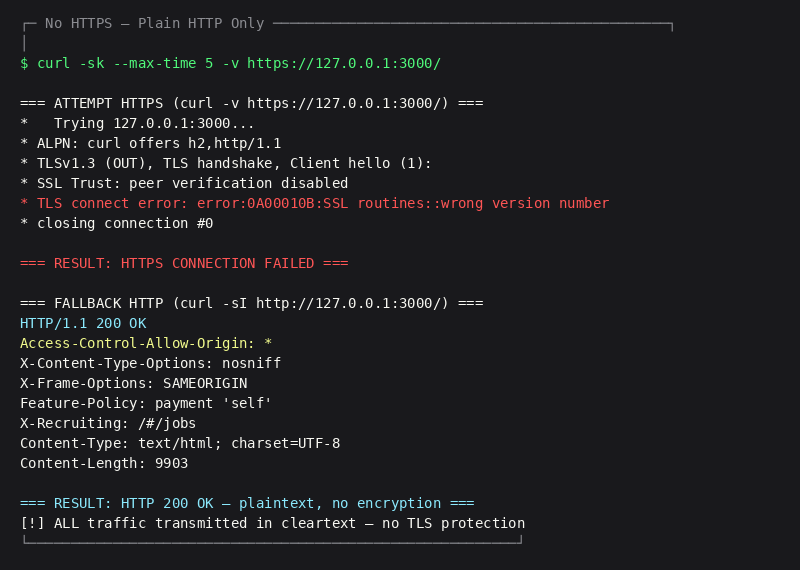
If exploited, sensitive data is fully exposed to unauthorized parties; attackers can modify or corrupt critical data.
1. Obtain TLS certificate. 2. Configure HTTPS. 3. Implement HTTP-to-HTTPS 301 redirect. 4. Enable HSTS. 5. Disable plain HTTP in production.
Directory Listing on /ftp
Attackers can browse and enumerate every file in the /ftp directory without needing to guess filenames. The directory listing reveals 10 files including confidential business acquisition documents, an encrypted KeePass password database (incident-support.kdbx — 3.2 KB), Python source code (encrypt.pyc), and multiple backup files that may contain credentials or internal configuration.
CVSS:3.1/AV:N/AC:L/PR:N/UI:N/S:U/C:H/I:N/A:N
curl -s http://127.0.0.1:3000/ftp | grep 'href' Returns full directory listing with 10 files exposed:Evidence Screenshot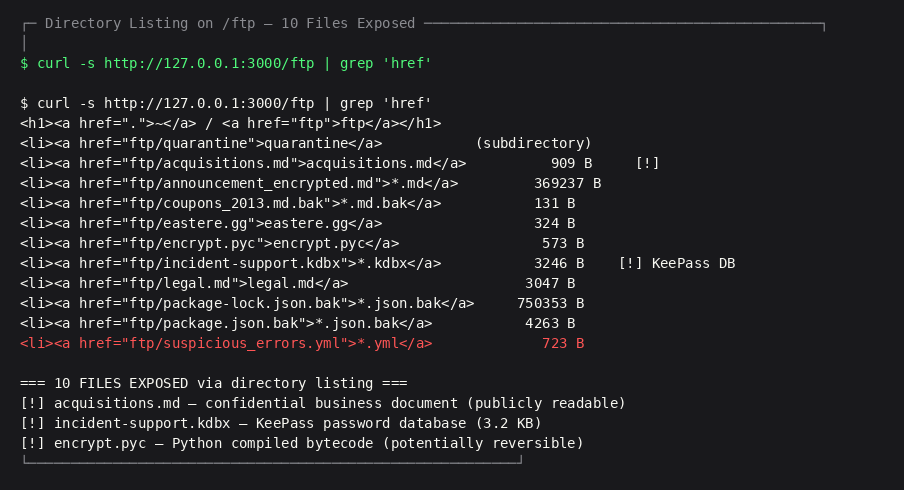 Impact
If exploited, sensitive data is fully exposed to unauthorized parties.
Remediation1. Disable directory listing. 2. Restrict /ftp to authenticated users. 3. Remove sensitive files from web-accessible directory. 4. Move files outside web root.
Confidential Document Exposure
Attackers can download internal business strategy documents including planned company acquisitions, projected revenues, and strategic plans without any authentication. This enables corporate espionage, competitive intelligence gathering, and insider trading on pre-public acquisition targets directly from the acquisitions.md file.
CVSS:3.1/AV:N/AC:L/PR:N/UI:N/S:U/C:H/I:N/A:N
curl http://127.0.0.1:3000/ftp/acquisitions.md

Returns 909-byte Markdown document titled '# Planned Acquisitions' with internal business strategy.
If exploited, sensitive data is fully exposed to unauthorized parties.
1. Immediately remove acquisitions.md from web-accessible directory. 2. Implement proper file access controls. 3. Audit /ftp for other sensitive files. 4. Move internal docs to secure storage.
Missing Content-Security-Policy Header
Attackers who discover any cross-site scripting vector can inject and execute arbitrary JavaScript in users' browsers with no restrictions, steal session tokens and authentication cookies, exfiltrate sensitive data to attacker-controlled servers, and perform any action as the victim user because no Content Security Policy restricts which scripts can execute, where data can be sent, or what external resources can be loaded.
CVSS:3.1/AV:N/AC:L/PR:N/UI:R/S:U/C:L/I:L/A:N
curl -sI http://127.0.0.1:3000/ | grep -i content-security

No output — CSP header is completely absent.
If exploited, limited confidential information is disclosed; limited data tampering is possible.
1. Implement strict CSP: default-src 'self'; script-src 'self'; style-src 'self'. 2. Avoid unsafe-inline and unsafe-eval. 3. Use nonce-based CSP for inline scripts. 4. Test with Report-Only first.
Exposed Prometheus Metrics
Attackers can access detailed operational intelligence including request volumes, error rates, file upload statistics, LLM token usage, and 275 internal application metrics without any credentials. This enables precise attack surface profiling, sensitive data enumeration, and timing analysis to identify optimal exploitation windows.
CVSS:3.1/AV:N/AC:L/PR:N/UI:N/S:U/C:L/I:N/A:N
curl -s http://127.0.0.1:3000/metrics | head -20

Returns operational metrics, request counts, and internal application statistics.
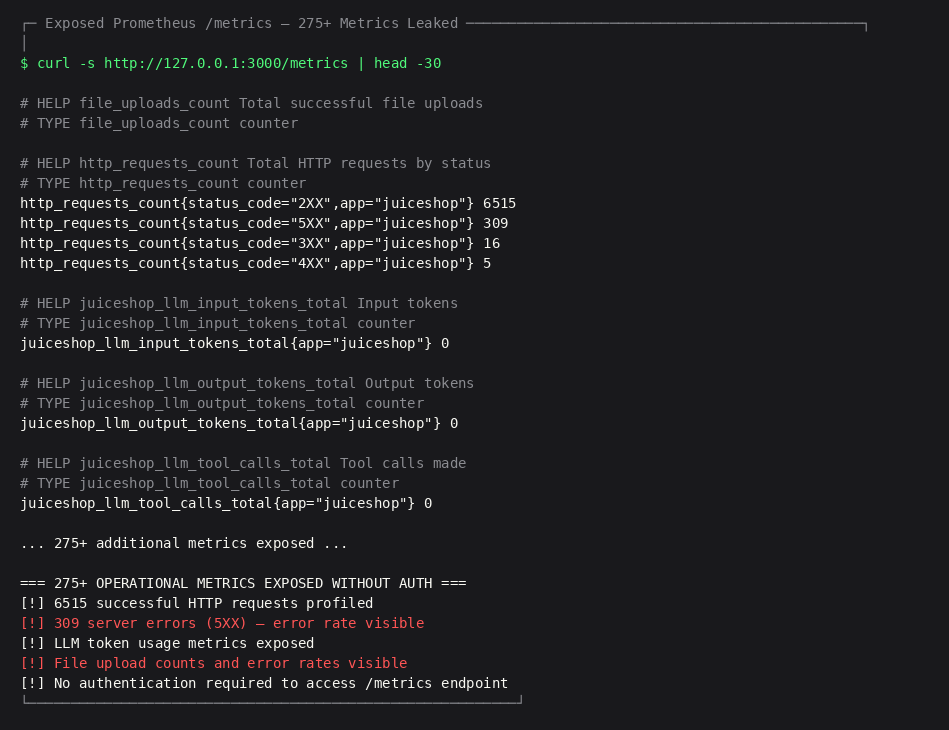
If exploited, limited confidential information is disclosed.
1. Require authentication for /metrics endpoint. 2. Use reverse proxy with auth (nginx auth_basic). 3. Bind metrics server to localhost only. 4. Set metrics.includeHttpMetrics: false in Juice Shop config.
Swagger API Documentation Exposed
Attackers gain a complete interactive map of the entire REST API — all endpoints, request/response schemas, authentication mechanisms, and parameters — through the publicly accessible Swagger UI. This provides a methodical exploitation blueprint, letting attackers probe every API function without trial-and-error guessing and identify the most valuable targets.
CVSS:3.1/AV:N/AC:L/PR:N/UI:N/S:U/C:L/I:N/A:N
curl -s http://127.0.0.1:3000/api-docs/swagger.json

Returns full OpenAPI specification with all API endpoints documented.
If exploited, limited confidential information is disclosed.
1. Disable Swagger UI in production. 2. Restrict /api-docs/ to authenticated admins. 3. Remove sensitive endpoint docs from public Swagger spec.
Score Board Exposed Without Authentication
Attackers gain a complete exploitation roadmap for the application: a searchable catalog of 178 challenges organized by vulnerability category (Broken Access Control, XSS, Injection, Sensitive Data Exposure, Security Misconfiguration, and 9 more categories) with names, difficulty ratings, and solution hints — letting attackers systematically exploit every intended vulnerability without reconnaissance effort.
CVSS:3.1/AV:N/AC:L/PR:N/UI:N/S:U/C:L/I:N/A:N
Navigate to http://127.0.0.1:3000/#/score-board
Shows full challenge catalog: 27 Broken Access Control, 28 XSS, 47 Injection, 28 Sensitive Data Exposure, 25 Security Misconfiguration, plus 9 more categories.
If exploited, limited confidential information is disclosed.
1. Require admin authentication for Score Board. 2. Hide challenge details from unauthenticated users. 3. Use separate admin interface. 4. Implement rate limiting on challenge endpoints.
Overly Permissive CORS Configuration
Attackers operating malicious websites can make cross-origin API requests to the application from any domain and read unauthenticated API responses, bypassing the browser's same-origin policy. While authenticated requests are blocked (no Access-Control-Allow-Credentials), attackers can still enumerate public API data, perform unauthenticated operations, and conduct information-gathering attacks from any origin.
CVSS:3.1/AV:N/AC:L/PR:N/UI:N/S:U/C:L/I:N/A:N
curl -X OPTIONS -D- http://127.0.0.1:3000/api/Challenges/

Returns:
Access-Control-Allow-Origin: *
Access-Control-Allow-Methods: GET,HEAD,PUT,PATCH,POST,DELETE
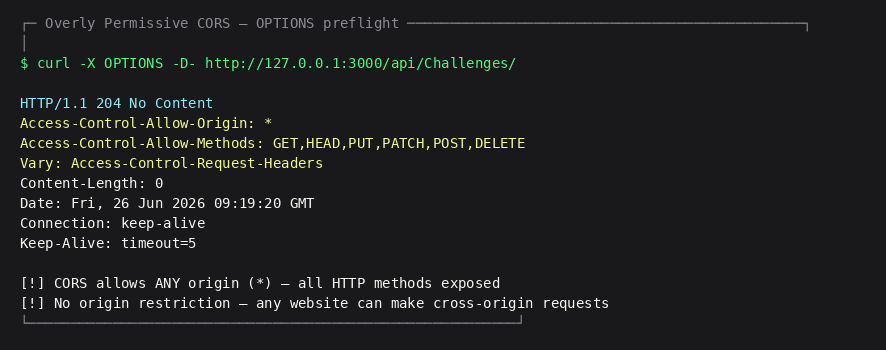
If exploited, limited confidential information is disclosed.
1. Never use Access-Control-Allow-Origin: *. 2. Specify exact allowed origins. 3. Restrict allowed methods to minimum required. 4. Implement proper preflight validation. 5. Use Access-Control-Allow-Credentials only with specific origins.
Deprecated Feature-Policy Instead of Permissions-Policy
Attackers exploiting any content injection vulnerability gain access to users' camera, microphone, geolocation, and other sensitive browser APIs because only the payment API is restricted. The deprecated Feature-Policy header provides no protection in modern browsers, allowing attackers to spy on users through device sensors and capture audio/video without detection.
CVSS:3.1/AV:N/AC:L/PR:N/UI:R/S:U/C:N/I:L/A:N
curl -sI http://127.0.0.1:3000/ | grep Feature

Returns: Feature-Policy: payment 'self'

No Permissions-Policy header present.
If exploited, limited data tampering is possible.
1. Replace with Permissions-Policy header. 2. Define comprehensive policy: camera=(), microphone=(), geolocation=(), payment=(self). 3. Restrict all sensitive browser features by default.
Missing Strict-Transport-Security Header
Attackers positioned to intercept network traffic through ARP spoofing, rogue access points, or compromised routers can exploit the absence of HSTS to downgrade connections to plain HTTP, strip any future TLS, and intercept or modify traffic between users and the application without the browser displaying security warnings. Combined with no HTTPS deployment, all traffic is vulnerable to passive eavesdropping.
CVSS:3.1/AV:N/AC:H/PR:N/UI:N/S:U/C:L/I:N/A:N
curl -sI http://127.0.0.1:3000/ | grep -i strict-transport

No output — HSTS header is completely absent.
If exploited, limited confidential information is disclosed.
1. Enable HTTPS with TLS certificate. 2. Add header: Strict-Transport-Security: max-age=31536000; includeSubDomains; preload. 3. Redirect all HTTP to HTTPS (301).
Missing Referrer-Policy Header
Attackers can exfiltrate sensitive data embedded in URLs through the Referer header when users navigate from the application to any external site. Session tokens, password reset codes, search queries, and internal navigation state in URL parameters leak to third-party analytics platforms, advertising networks, and hostile domains, enabling session hijacking and disclosure of sensitive user activity.
CVSS:3.1/AV:N/AC:H/PR:N/UI:R/S:U/C:L/I:N/A:N
curl -sI http://127.0.0.1:3000/ | grep -i referrer

No output — Referrer-Policy header is absent.
If exploited, limited confidential information is disclosed.
1. Add Referrer-Policy: strict-origin-when-cross-origin or no-referrer. 2. Never pass sensitive data in URL parameters. 3. Use POST for sensitive data transmission.
X-Recruiting Header Information Leak
Attackers can fingerprint the application's internal technology stack and organizational structure through custom HTTP headers that reveal internal application paths and technology choices, accelerating reconnaissance by reducing the effort required to identify and target vulnerable components and map the application's internal architecture.
CVSS:3.1/AV:N/AC:H/PR:N/UI:N/S:U/C:L/I:N/A:N
curl -sI http://127.0.0.1:3000/ | grep X-Recruiting

Returns: X-Recruiting: /#/jobs
If exploited, limited confidential information is disclosed.
Remove X-Recruiting header or replace with full external URL. Avoid revealing internal path structures in HTTP headers.
robots.txt Reveals Sensitive Directory
Attackers who retrieve robots.txt immediately discover the /ftp directory containing sensitive files such as acquisitions.md, incident-support.kdbx, and backup source code. The Disallow directive acts as a directory index for restricted paths, effectively directing attackers to the exact locations the application operators attempted to hide.
CVSS:3.1/AV:N/AC:H/PR:N/UI:N/S:U/C:L/I:N/A:N
curl http://127.0.0.1:3000/robots.txt

Returns: User-agent: *
Disallow: /ftp
If exploited, limited confidential information is disclosed.
Remove /ftp Disallow from robots.txt. Implement proper access controls instead of relying on robots.txt for security.
Application Fingerprinting via Headers
Attackers can precisely identify the application as OWASP Juice Shop v20.0.0 by Bjoern Kimminich through detailed HTTP headers (ETag, Accept-Ranges) and HTML source comments containing copyright statements. This enables targeted exploitation of version-specific vulnerabilities, matching of known CVEs, and use of Juice Shop-specific attack tools without any reconnaissance trial-and-error.
CVSS:3.1/AV:N/AC:H/PR:N/UI:N/S:U/C:L/I:N/A:N
curl -sI http://127.0.0.1:3000/
Headers reveal: Accept-Ranges, ETag, Feature-Policy, X-Recruiting.
HTML reveals:
If exploited, limited confidential information is disclosed.
1. Remove/obfuscate version info from headers. 2. Remove copyright comments from production HTML. 3. Set generic Server header. 4. Disable verbose error messages.